WOUND CARE CHALLENGEs
IDENTIFYING KEY BARRIERS TO
HEALING TO IMPROVE OUTCOMES
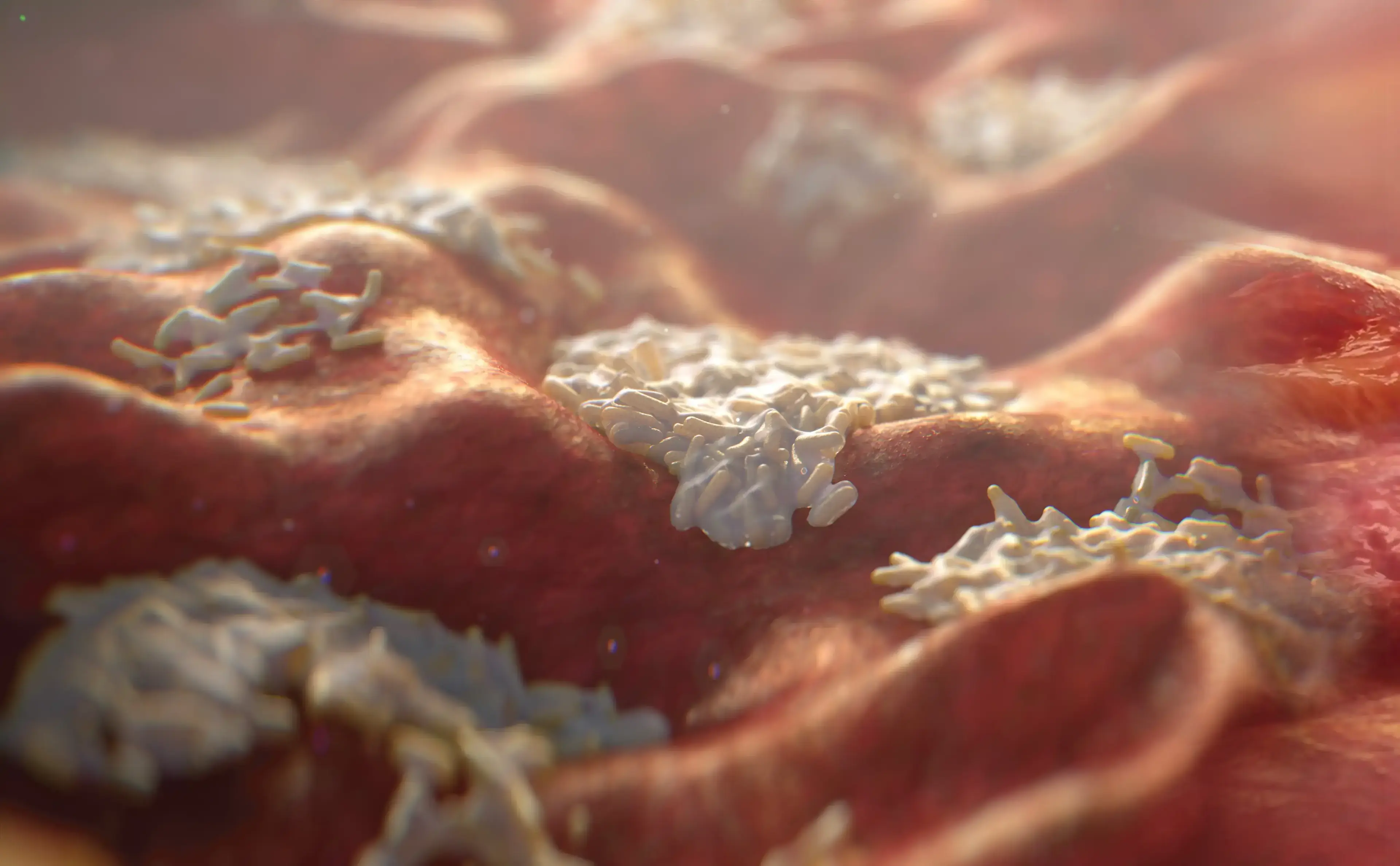
In acute and chronic wounds, uncontrolled bioburden can lead to biofilm resulting in excess MMPs and a continuous inflammatory response, which can break down the ECM and contribute to stalled, non-healing wounds1-5
MMPs=matrix metalloproteinasesECM=extracellular matrix
Stalled Inflammatory Phase (Non-healing Wound)
BIOFILM
Inflammation
MMPs
DEGRADATION
BIOFILM
Inflammation
MMPs
DEGRADATION
Support Healing with Optimal Wound Control
Support Healing with Optimal Wound Control
UTILIZING AN ECM SCAFFOLD +
BROAD-SPECTRUM PHMB ANTIMICROBIAL
For optimal wound healing support, combine standard of care with an ECM scaffold for cellular migration and proliferation (in vitro) and provide sustained antimicrobial effectiveness within the product5,7-9
Key components for next-level healing support
Assess the
wound8
- Assess the need for debridement8
- Debridement reduces necrotic tissue, contamination, and biofilm3,8
- Biofilm can reform rapidly within 1 to 3 days10
Utilize an ECM
scaffold5,9
- ECM acts as a scaffold for cellular migration and proliferation5,9
- Aids in granulation tissue formation5,9
Provide sustained
antimicrobial
effectiveness within
the scaffold7,8
Ideal antimicrobial3,11:
- Broad-spectrum
- Low incidence of microbial resistance
- High tissue compatibility
- Low cytotoxicity
Eliminate the need
for at-home primary
dressing changes
- Healthcare studies show that patient adherence improves when treatments require less intervention12
Assess the
wound8
Utilize an ECM
scaffold5,9
Provide sustained
antimicrobial
effectiveness within
the scaffold7,8
Eliminate the need
for at-home primary
dressing changes
- Assess the need for debridement8
- Debridement reduces necrotic tissue, contamination, and biofilm3,8
- Biofilm can reform rapidly within 1 to 3 days10
- ECM acts as a scaffold for cellular migration and proliferation5,9
- Aids in granulation tissue formation5,9
Ideal antimicrobial3,11:
- Broad-spectrum
- Low incidence of microbial resistance
- High tissue compatibility
- Low cytotoxicity
- Healthcare studies show that patient adherence improves when treatments require less intervention12
IMPROVING PATIENT LIVES STARTS WITH CHOOSING A SOLUTION THAT MEETS THEIR NEEDS
- Nonhealing wounds significantly impact patient quality of life13,14
- At-home primary dressing changes can expose the wound to bacteria and lead to contamination
- Many patients with lower-extremity chronic wounds are unable to change their own dressings15
- Many patients fear touching their wounds and prefer a doctor or a nurse exclusively to control their care16
PuraPly® AM and PuraPly® XT can help eliminate at-home
primary dressing changes between patient treatments.

Please refer to the PuraPly AM Instructions for Use and
PuraPly XT Instructions for Use for complete prescribing information.
1. Percival SL, et al. Adv Wound Care. 2015;4(7):389-397. 2. Frykberg RG, et al. Adv Wound Care. 2015;4(9):560-582. 3. Carpenter S, et al. Wounds. 2016;28(6 suppl):S1-S20. 4. Gibson D, et al. Wounds Int. 2009;1(1):1-6. 5. Brett D. Wounds. 2008;20(12):347-356. 6. Brantley J, et al. Wounds Int. 2016;7(3):1-5. 7. Davis SC, et al. Int Wound J.2022;19(1):86-99. 8.International Wound Infection Institute (IWII) Wound Infection in Clinical Practice. Wounds International. 2022. 9. Araujo TAT, et al.J Biomater Appl. 2021;36(1):95-112. 10. Wolcott RD, et al.J Wound Care. 2010;19(8):320-328. 11. Gottrup F, et al.J Wound Care. 2013;22(Suppl):S1-S92. 12. Atreja A, et al.MedGenMed. 2005;7(1):4. 13.Sawad A, et al. J Comp Eff Res. 2020;9(13):907-918. 14. Mathias SD, et al. Adv Skin Wound Care. 2000;13(2):76-78. 15. Fife C, et al. Wounds. 2007;19(10):255-257. 16. Zulec M, et al. Int J Environ Res Public Health. 2019;16(4):e559.